
Hydrogen fuel cell generators are an emerging, zero-emission backup power solution for telecommunications towers. They offer long-duration, reliable, and environmentally friendly operation compared to diesel or battery-only systems. HHLLC hydrogen systems provide cutting-edge solutions for reliable primary and backup power needs.
Typical hydrogen generator systems produce electricity through an electrochemical reaction between hydrogen and oxygen, without combustion.
Hydrogen enters the anode, where it separates into protons and electrons. The electrons flow through an external circuit to power the tower, while the protons combine with oxygen at the cathode to produce water and heat. This process continues as long as hydrogen is supplied.
HHLLC systems focus on the complete solar/wind-hydrogen energy cycle: capturing green energy from sources such as solar and wind, producing green hydrogen through efficient electrolysis, safely and effectively storing hydrogen using advanced low-pressure methods, and generating clean electricity on demand using state-of-the-art fuel cells, supercapacitors, and/or alternative electrostatic energy storage systems.
Cell towers require mission-critical, uninterrupted power. In the U.S., many sites are required by law to maintain at least eight hours of backup power. HHLLC systems provide continuous energy supply and extended backup power to help maintain reliable operations.
No moving parts, long life, and instant startup.
Zero CO emissions; only water and heat as byproducts
Suitable for urban or residential areas.
With HHLLC Hydrogen is stored onsite, avoiding diesel or hydrogen delivery challenges in remote sites.
HHLLC Hydrogen Systems can be designed as stand-alone off grid installations or used as supplemental emergency backup power on demand.
Over 2,000 5kW hydrogen fuel cells are already in use for telecom backup, many in remote areas.
HHLLC uses solar amplified/wind, hydrogen systems to produce hydrogen during the day and store it for night use, and extended emergency backup without external fuel delivery.
Avoids fuel transport, noise, and emissions of diesel; reduces maintenance.
HHLLC offers hydrogen & alternative electrostatic energy storage systems providing non chemical, non flammable, non explosive, longer runtime with less degradation over years than lithium battery storage.
Hydrogen backup for cell towers combines sustainability, reliability, and operational flexibility, making it a compelling alternative to diesel and lithium-battery-only systems. These solutions are suitable for a range of environments, including remote, urban, and environmentally sensitive locations.
Hydrogen Holdings LLC was founded on a vision of a future where clean, reliable energy is accessible whenever and wherever it is needed. We are at the forefront of the clean energy revolution, dedicated to developing and deploying advanced hydrogen technologies that bridge the gap between renewable energy potential and real-world, around-the-clock power delivery.
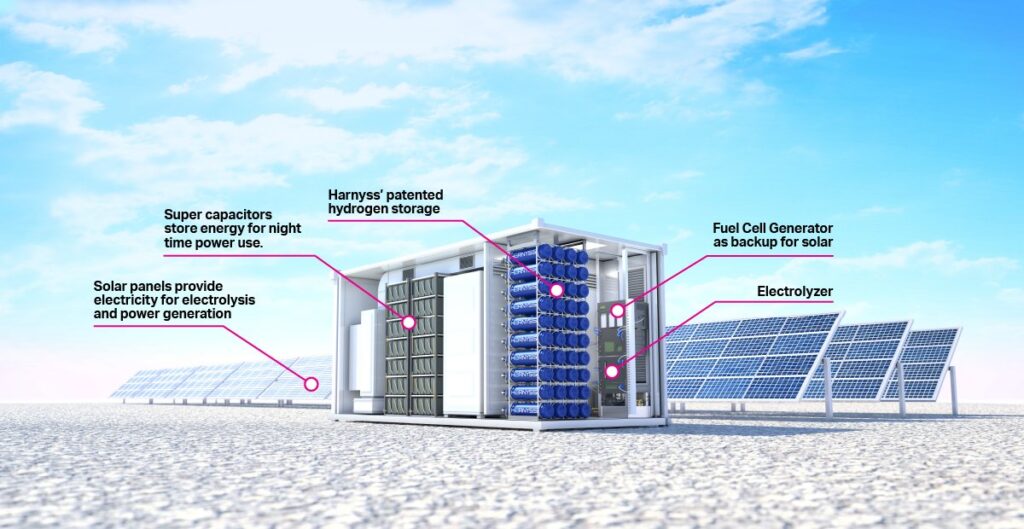
The Oasis (“Microgrid-in-a-Box”)
A container-sized, plug-and-play power unit that integrates hydrogen production, atmospheric water capture or onboard electrolysis, solid-state storage, fuel cells, and graphene-based supercapacitors.
Low-Pressure Storage
Uses proprietary metal hydride alloy formulations to store hydrogen at roughly 250 psi (about 17 to 35 barg), which is up to 10 times lower than standard high-pressure hydrogen tanks (around 2,500 psi).
Solid-State & Non-Pyrophoric
Hydrogen is safely bound inside canisters using abundant, non-rare-earth minerals rather than being stored as a volatile compressed gas or inside flammable lithium-ion batteries.
Performance Lifespan
Designed for long-duration energy storage, with the capability to power residential or commercial setups, remote military installations, and mobile nanogrids over a multi-decade operational period.
Rather than using high-pressure mechanical compressors, the system uses internal AEM or PEM electrolyzers to split water. The resulting hydrogen gas binds directly to abundant, non-rare-earth metal alloys inside low-pressure canisters.
When power is needed, the system drops the internal resistance, allowing the hydrogen to desorb naturally as a gas into an integrated fuel cell, where it is converted back into electricity.
The systems operate as a closed-loop, bidirectional energy storage mechanism that addresses the intermittency issues of solar arrays and wind turbines.
Primary Buffer
Solar or wind energy directly charges a fast-acting battery or supercapacitor bank, which handles localized electrical loads when the system is not connected to the grid.
Excess Energy Capture (Electrolysis)
When renewables generate excess power (e.g., during peak afternoon sunlight), the internal energy management system triggers onboard water capture and electrolysis, transforming excess energy into solid-state hydrogen.
Long-Duration Backup
If the grid connection is interrupted and power is no longer being supplied, or when solar and/or wind generation cannot meet energy requirements, the system automatically initiates the hydrogen loop.
The metal hydrides release hydrogen to fuel the cells, which take over the load and provide the energy required to run the facilities. When alternative hydrostatic energy storage systems are integrated, they can also safely recharge the central battery bank until renewable generation resumes.
The cost of Harnyss Oasis containers depends on custom MWh sizing, site preparation, and specific military or civilian requirements.
Their operational financial profiles focus heavily on diesel and lithium battery displacement.
Levelized Cost of Storage (LCOS)
The primary value proposition is a lower multi-decade cost curve compared to conventional diesel generator and lithium battery setups.
By utilizing non-degrading metal hydrides and eliminating the need for high-maintenance, high-pressure compressors, the infrastructure yields a 20+ year lifespan with minimal service overhead.